
Brennan Termite & Pest Control eliminates yellowjacket, hornet, wasp, and carpenter bee nests in Bellmore. Nighttime treatment. Family-owned since 1977. Call (516) 221-6329.
The yellowjackets at the patio table in August are not random. They are foragers from a colony somewhere within several hundred feet of your backyard. They are drawn by protein sources, which in late summer means outdoor meals, pet food, open trash, and the insects that concentrate near the South Shore wetland edges that back many Bellmore properties. The colony itself may be in the eave of your home, in your lawn, in a neighbor’s yard, or along a landscape border you have not examined closely.
Finding where the nest is matters. Yellowjackets foraging from an on-property nest will escalate in number and aggression as the season peaks. A nest that is tolerated in June, when the colony is small, becomes a safety problem by August, when it is not. If anyone in your household has a bee or wasp allergy, the calculus changes further.
Brennan Termite & Pest Control has served Bellmore homeowners since 1977, based less than ten minutes away in Seaford. Brennan technicians locate stinging insect nests in Bellmore properties, identify the species, and treat the colony after dark when elimination is most complete and safest for your household. Call (516) 221-6329 any time. Available 24/7.

Bellmore’s proximity to South Shore wetlands creates conditions that sustain yellowjacket activity later into the season than inland Nassau County communities. Wetland edges and the adjacent landscaped borders of Bellmore properties provide both protein-rich insect prey and the loose, humid soil conditions that ground-nesting yellowjackets prefer.
This means that stinging insect pressure in Bellmore is not limited to nests established on a homeowner’s property. Yellowjackets forage across a range of several hundred yards. A colony established in a neighbor’s yard, along a drainage area, or in the woody debris near a wetland edge can generate visible forager activity at your patio, near your garbage cans, or at the edge of your lawn without any nest being present on your land.
On-property nests are the ones that can be located and treated. When Bellmore homeowners call Brennan about recurring yellowjacket presence with no obvious nest on their property, the technician checks for the less obvious locations before advising on next steps.
Species identification determines nest location, risk level, and treatment method. A product that works for yellowjackets will not work for carpenter bees. Brennan confirms the species before any treatment is selected.
Yellowjackets are the species most likely to be the source of stinging incidents at Bellmore properties in late summer. Their colonies start small in spring and grow to several thousand workers by August. They become more aggressive as the season peaks, foraging more widely and defending the nest more intensively. In Bellmore homes, yellowjackets nest in two primary locations.
Eaves, soffits, and wall voids. Yellowjackets enter through small gaps at the soffit-fascia junction, around utility penetrations, and through deteriorated siding. Once inside a wall void, the colony builds quickly through summer. A wall void colony is a sustained risk: if workers cannot exit through the exterior opening, they find an alternative interior route, sometimes emerging through outlets, light fixtures, or baseboard gaps.
Ground nests. Yellowjackets also establish colonies in underground soil, particularly in sloped areas, garden bed borders, and along the edges of landscaped plantings. Ground nest entrances are flush with the surface and easy to miss until someone approaches too closely.
Brennan treats yellowjacket nests after dark when the full colony is inside the nest and inactive. After-dark treatment reaches the entire population in a single visit.
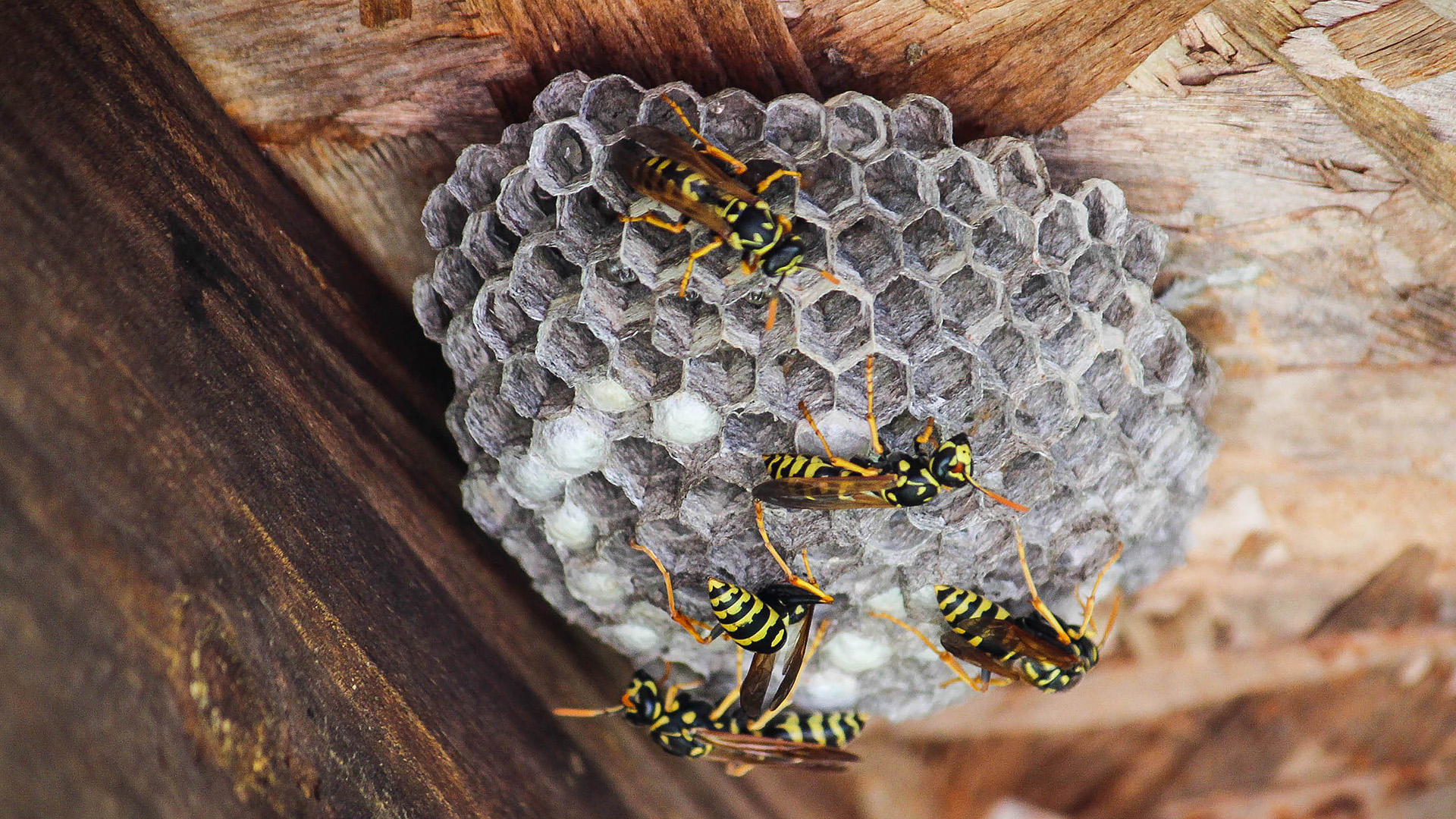
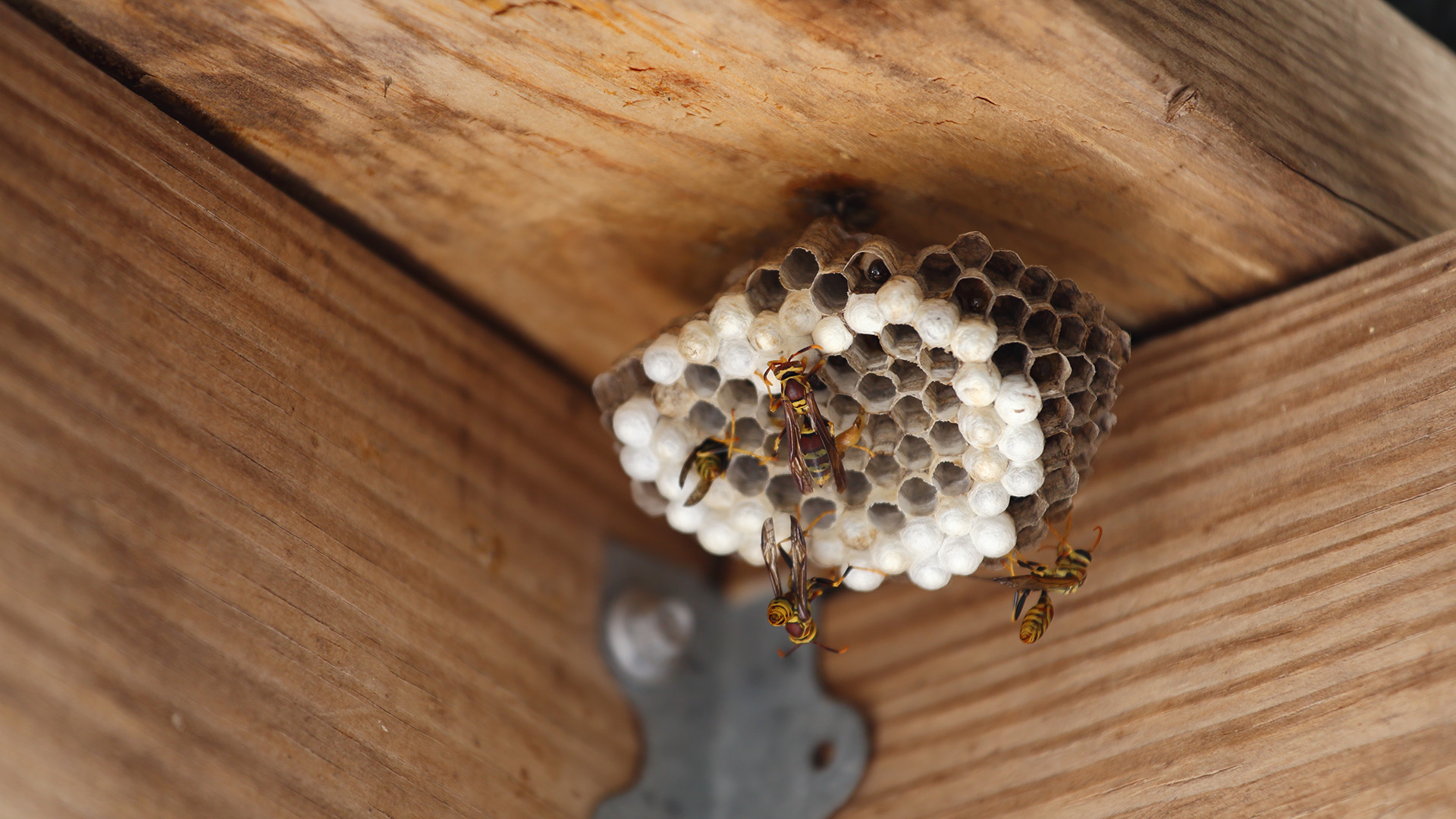
Paper wasps build open, umbrella-style nests most often under eaves, on the undersides of deck rails, and inside garage door frames. Their colonies are smaller than yellowjacket colonies and less aggressive when not directly threatened, but they sting when the nest is disturbed and they return to the same nest sites year after year. A paper wasp nest under the eave of a Bellmore home may be in the same location it has been for three or four seasons. Removing the nest structure after treatment reduces the likelihood of new queens establishing at the same site the following spring.
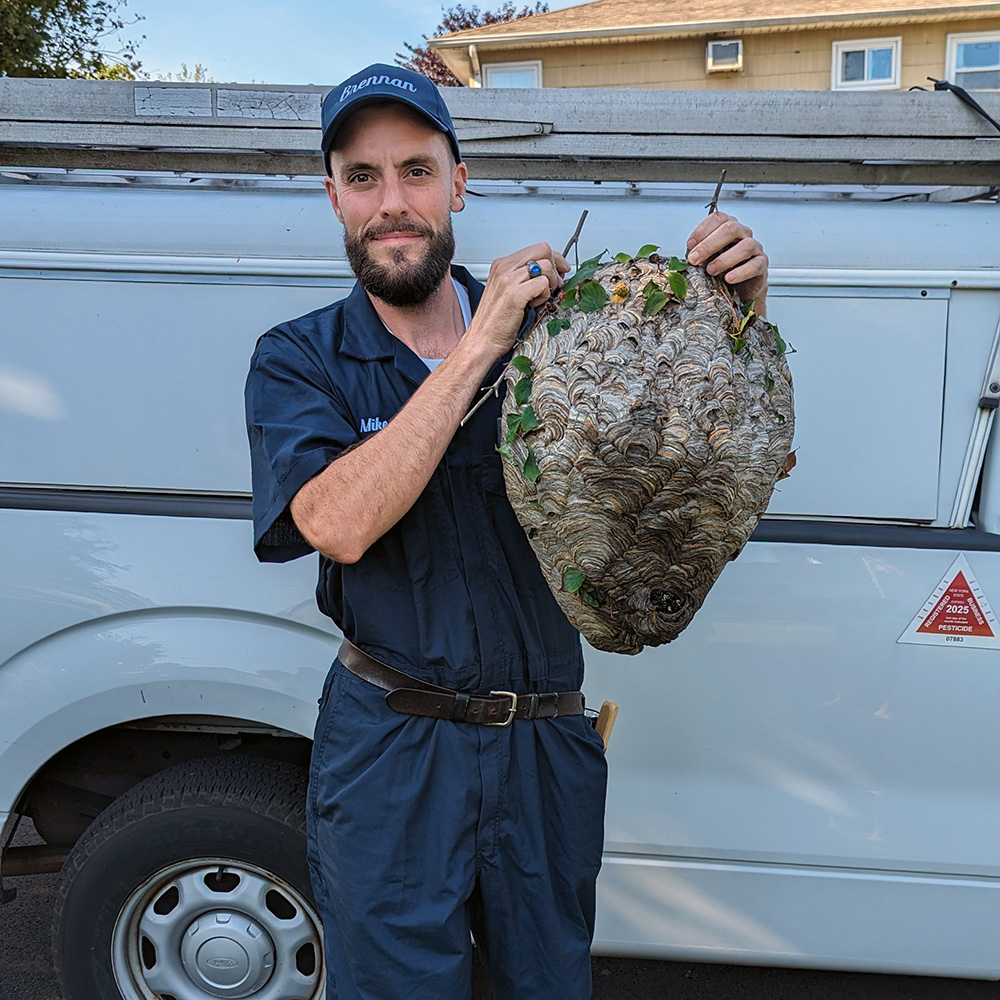
Bald-faced hornets build large, enclosed gray-paper nests in trees, shrubs, and on the exteriors of structures. The nests start small in spring and reach basketball size or larger by late summer. They are highly aggressive in defense and will sting repeatedly when the nest is disturbed or even approached. Brennan treats hornet nests after dark when the colony is at rest.
Carpenter bees are solitary, not colonial, but they return to the same wood surfaces year after year and their damage accumulates across seasons. They bore circular entrance holes, roughly the diameter of a finger, into soft or weathered wood. In Bellmore, where postwar homes have wood trim, fascia, decking, and fencing that has weathered for 50 or 60 years, carpenter bees find ample material. Effective carpenter bee treatment requires treating the galleries directly, not just sealing the exterior hole. Sealing without treatment traps larvae inside and leaves the wood as an active target for the following year.
Honey bee swarms appearing on Bellmore properties in spring are typically transient. Brennan does not exterminate honey bee colonies. A local beekeeper who performs live extraction is the appropriate resource for an established hive. Brennan can help confirm the species and advise accordingly.
Species and nest location confirmed first. The technician identifies the species and locates the nest before any product is selected. Treatment for a yellowjacket ground nest is different from treatment for a wall void colony, which is different from treatment for a paper wasp nest under an eave.
After-dark treatment. Yellowjacket, hornet, and paper wasp nests are treated at night when the colony is fully inside the nest and inactive. This timing allows Brennan to reach the full population in a single application.
No premature sealing. The nest entrance is not sealed before treatment. Sealing first traps the colony inside without eliminating it, which can force workers to find an interior route through the wall. Brennan treats the colony first and advises on sealing after elimination is confirmed.
Nest removal where accessible. Paper wasp combs under eaves and accessible hornet nests are removed after the colony is eliminated. This reduces new queen establishment at the same site the following spring.
Gallery treatment for carpenter bees. Brennan applies product directly into active carpenter bee galleries before advising on sealing and surface treatment to prevent return activity in subsequent seasons.
Full explanation before leaving. The technician explains what was found, what was applied, and what to expect in the following 24 to 48 hours.
Free return visit if needed. If follow-up treatment is required, Brennan returns at no additional charge.
The information a Brennan technician finds most useful before an inspection is what the homeowner has observed. If you are seeing consistent stinging insect activity, the following observations help locate the nest more quickly.
Note where the activity concentrates. Foragers trail between the nest and food sources. If you are seeing yellowjackets consistently near a specific corner of the house, a particular section of the fence line, or at the edge of a garden bed, that concentration points toward where the nest is.
Note the direction foragers are traveling. Yellowjackets returning to the nest fly in a fairly direct line from food sources. Watching the direction of flight after a forager leaves a food source can help narrow down the nest location.
Do not approach any suspected nest entrance. If you have identified what looks like a nest entrance, stop there. Do not spray it, do not block it, and do not disturb the area. A disturbed nest is more dangerous than an undisturbed one, and disrupting forager trails before the inspection makes nest location harder.
Brennan is headquartered at 2085 Paddock Rd. in Seaford, less than ten minutes from Bellmore. When you call, you reach a local company with direct knowledge of this community.
Brennan has removed yellowjacket, hornet, and carpenter bee infestations from Nassau County homes since 1977. The South Shore seasonal patterns and housing stock in Bellmore are familiar ground.
After-dark treatment is more effective than daytime treatment because the full colony is present. Brennan technicians are available and equipped to work evening hours because it is the right approach, not because it is convenient.
Follow-up is included when the treatment requires it.
A 5.0 rating on Google (83 reviews), Yelp (40 reviews), and Angi (7 verified reviews). Active NPMPA certification with a Customer Trust Score of 94. Zero BBB complaints on file.
Brennan treats the pest problem at hand. When it is resolved, there is nothing to cancel.
Not necessarily. Yellowjackets forage several hundred yards from the nest. The colony could be in your eave, in your lawn, or on a neighboring property, and the foragers can still reach your outdoor dining area. Brennan can help locate an on-property nest if one is present. If the forager pressure is coming from a neighboring property or a shared landscape area, the technician will advise on what options exist.
Waiting until the colony dies in late fall is an option if the nest is not near an occupied area, if no household member has a sting allergy, and if there is no interior access route through the wall. If the nest is inside a wall adjacent to a living space, if workers have appeared indoors through an outlet or fixture, or if the exterior entrance is near a door or window, waiting carries risk. Brennan can assess the situation during a free inspection and advise on whether treatment is warranted.
The nest material remains inside the wall cavity after treatment. It will not decompose to attract secondary pests in the short term. Brennan will advise on sealing the exterior entrance point after the colony is confirmed eliminated.
Paper wasps are less aggressive than yellowjackets in that they generally do not defend a territory around the nest the way yellowjackets do. They will sting when the nest is directly disturbed or when a person comes into close contact with the nest itself. A paper wasp nest directly above a doorway or on a deck rail that is regularly used is a realistic stinging hazard. Brennan removes accessible nest structures after treatment to reduce new establishment at the same location the following spring.
Yes. Carpenter bee treatment is part of Brennan’s stinging insect services in Bellmore. Effective treatment requires applying product directly into active galleries, not just treating the exterior surface. Brennan advises on the timing and materials for sealing and surface treatment after gallery treatment to prevent return activity in the following season.
Brennan technicians explain every product used during a visit, including any guidance for children and pets. After nighttime treatment of a yellowjacket nest, some dead workers may exit the treated area over the following day. Your technician will walk you through what to expect before leaving.
Briefly let us know how we can help and we will contact you via your email.
Please leave your phone number if you would prefer a phone call.
Posted on Google
 nadene mccarthy
Trustindex verifies that the original source of the review is Google.
Excellent customer service! The techs Mike and Mike were super knowledgeable, informative and clearly wanted us to be happy. Highly recommend!Posted on Google Christopher JoyceFirst time customer - I called Mike Brennan after being referred by my family member. He answered my call, evaluated the situation, gave me some incredibly helpful tips to address the immediate issue, and fit me in after his last appointment on the same day. Mike and his associate (also Mike) arrived when they estimated, inspected the problem area, got to work, eliminated the problem and sealed the area all within an hour. The job was foul and they got pretty dirty, but they maintained their professionalism throughout. It’s doubtful you’ll find a more professional team in the area. Though I hope I will not need this particular service ever again, I would not hesitate to call them should the need arise. Thank you Mike and Mike!Posted on Google
 Mercedes Cueva MarinExcellent service from start to finish. He was professional, punctual, honest, and extremely knowledgeable about termite treatment. From the initial inspection, he took the time to explain everything in detail with great patience, helping us understand exactly what was happening in our home, where the termites were likely coming from, and the best way to treat the problem. Thanks to his expertise, he correctly identified the source and created a detailed, effective treatment plan focused on the affected areas and around the home. He and his team completed the work efficiently and respectfully. It’s rare to find someone so trustworthy, dedicated, and clearly passionate about what they do. I highly recommend their service.Posted on Google
 Donna WernertMike was professional, neat and explained everything . I would recommend him for any type of pest control you may need.Posted on Google
 Michele FedeleMike is very knowledgeable. He explained how he was going to treat the area. It’s great to do business with a local family.Posted on Google
 Cindy WillisI see why he has a 5 STAR RATING. Did a great job at my house last week, professional...arrived at the exact time he said....fair pricing.....knowledgeable....and even explained everything he was going to do to treat. I will never use anyone else for my exterminating needs. A keeper...unlike the pests he treats!!! Thanks Mike....nice to give the business to a local family owned business that takes pride in their work.Posted on Google
 Karyn ZubkoI’ve been using this company for over 15 years!!! Simply the best!!!Posted on Google
 David KaufmanMike is awesome! Really such an absolute pleasure to deal with. Randomly found him searching online (was looking for a truly family owner and operated business) and he didnt disappoint. We had an earwig infestation. I called Mike and he is probably one of the most patient human beings I have met. He spent time discussing the issue and the treatment. There was absolutely no pressure to use him. We ended up using him and he came and again explained everything he was doing.. he was extremely thorough and it's a month and half later and we are still bug free.Posted on Google
 David JohnsonMike is such a fantastic guy! He goes above and beyond for us every time! Squirrels, rickets, yellow jackets... they do it all!!Load more